1. Designing for Openness
| 🎯 Learning Outcomes | 📍 Guiding Questions |
|---|---|
|
|
You have a training design. It has structure, outcomes, activities, and assessment. It works — when you are in the room.
In Part 1, you worked through how people learn, what your learners need, the systems your training sits within, and the change you are aiming to contribute to. You made decisions about outcomes, activities, and evaluation.
Now you need to turn that design into materials.
The question is not only what will you create?
It is also: what will you reuse, what will you adapt, and what needs to be created from scratch?
This lesson introduces a way of thinking about those decisions — through the ethos of open educational resources.
Why this matters
Designing training materials is not just a technical task. It reflects how you think about knowledge, learning, and your role as a facilitator.
An “open” approach does not start with publishing or licensing. It starts with how you design:
- whether your materials can be understood and reused later — by you
- whether learners can return to them to apply and build on what they learned
- whether others can adapt them to different contexts
When materials are designed with openness in mind:
- You benefit — your work becomes easier to revisit, adapt, and improve over time, rather than being recreated for each delivery
- Your learners benefit — materials remain usable beyond the session, supporting application, reflection, and different learning paths
- The wider world may benefit — knowledge can circulate, be adapted, and be built on across contexts rather than remaining locked in a single delivery
This is not about doing more work. It is about designing in a way that makes the work you are already doing more durable, adaptable, and useful.
Openness is not only about making your own materials reusable. It is also about contributing to a shared body of knowledge that others can build on — just as you build on resources created by others. Over time, this creates a network of materials that evolve across contexts rather than remaining tied to a single delivery.
This lesson helps you move from...
"What materials do I need to deliver this training?" to: "How do I design materials that can be reused, adapted, and built on — starting with my own work?"
Openness as a design approach
Openness is not a feature you add at the end. It is a way of making design decisions throughout your process.
An Open Educational Resource (OER) is a teaching or learning material that is openly licensed in a way that allows specific kinds of use.
A resource is considered “open” when you are allowed to:
- retain — keep and control a copy of the material
- reuse — use it in your teaching or learning
- revise — modify or adapt it
- remix — combine it with other materials
- redistribute — share it with others
These are often referred to as the 5 Rs of open educational resources.
This is what distinguishes OER from materials that are simply free to access. A resource you can view or download is not necessarily open. A resource becomes open when you have permission to act on it — to adapt, combine, and share it.
The 5 Rs describe what is possible with a resource. They do not determine what you should do — that depends on your learners, your context, and your design decisions.
It means being deliberate about:
- what you make explicit (instructions, purpose, assumptions)
- how your materials are structured (modular, adaptable)
- how they relate to context (what is fixed, what can change)
Think back to your Part 1 work.
You identified: - who your learners are - what they need - what constraints they operate under - what change is possible in that system
Those decisions directly shape what can be reused, what needs adaptation, and what must be created from scratch. Openness does not override those decisions — it works with them.
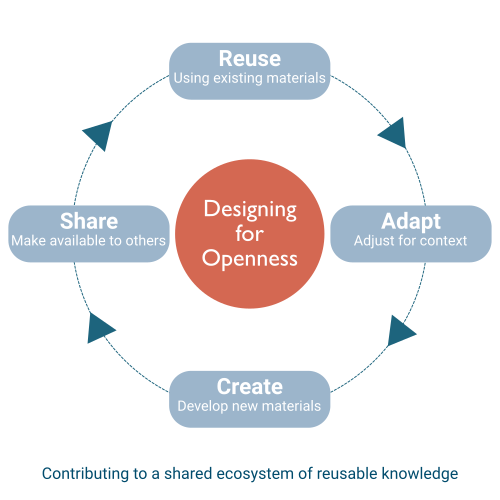
Three ways to build your materials
There are three main approaches you will use when developing your training materials:
- Reuse — use an existing resource as it is, because it already fits your learners, context, and outcomes
- Adapt — modify an existing resource to better align with your design decisions
- Create — build something new when no suitable resource exists
You will rarely use only one of these. Most training combines all three. The key is not choosing one approach in advance, but recognising which is appropriate for each part of your training. This lesson introduces these options. In the next lesson, you will evaluate and make decisions.
You will return to this decision throughout Part 2 — not as a one-time choice, but as a recurring pattern across your materials.
What makes materials usable and adaptable
For any of these approaches to work, materials need to be usable and adaptable. A resource is usable when you — or someone else — can understand how to use it without needing additional explanation. A resource is adaptable when it can be modified without breaking its purpose or structure.
In practice, this means:
- instructions are explicit, not assumed
- purpose is clear (what and why)
- context is visible (who it is for, what is needed)
- structure is modular (parts can be reused independently)
These are not “open” features in themselves. They are indicators of good design. Openness builds on them.
Key takeaway
You do not need to make everything perfect. You need to make it clear enough that someone else can reuse or adapt it with reasonable effort.
Hidden assumptions
Every resource carries assumptions — about who will use it, what tools they have, what they already know, and what context they work in. These assumptions are not problems in themselves. They become problems when they are invisible.
A slide deck that references "your department's LMS" assumes a specific institutional setup. An activity that asks learners to "open the dataset in R" assumes software access and a baseline of technical skill. A case study set in a European university assumes cultural familiarity that may not transfer to a training in Nairobi or Jakarta.
The assumptions you built into your Part 1 design — about your learners, their context, and their constraints — are the same ones that shape how reusable your materials are. Making those assumptions visible helps you:
- decide whether an existing resource fits your context
- understand what needs to be adapted
- make your own materials easier to reuse and apply
Here is a practical method for surfacing assumptions. Take one piece of your training materials and read through it as if you were a colleague who has never seen it before. For each section, ask:
- What does the reader need to already know? Note any assumed prior knowledge — technical skills, disciplinary background, or familiarity with specific tools.
- What does the reader need to have? Note any required tools, software, connectivity, or physical materials.
- What context is baked in? Note any examples, case studies, or references that assume a specific setting, culture, or institutional context.
Write these down directly in or alongside your materials. Even a short note — "This activity assumes learners have basic spreadsheet skills" — transforms a hidden barrier into a visible design choice that others can work with.
Trying it with your own materials
Start small. Choose one part of your training — a single activity, a set of slides, or a facilitator guide — and work through these two tasks:
Make one thing clearer
Pick the part of your material that relies most on what you would normally explain verbally.
Rewrite that section so it can stand on its own. Add the missing context: what learners should do, why they are doing it, what the expected output is, and how long it should take.
This improves usability for you, supports learners returning to the material to apply what they learned, and makes adaptation possible.
Make one assumption visible
From your assumption-surfacing exercise, choose the assumption that would cause the most confusion if someone missed it. State it directly in your materials. This might be a note at the top of an activity ("This exercise requires internet access and a Google account"), a comment in your facilitator guide ("Learners should have completed the pre-reading on qualitative methods"), or an alternative suggestion ("If learners do not have access to R, this analysis can be done in a spreadsheet").
Think about future use
Would this material still make sense if you used it again in six months, in a different location, or with a different group? What would another facilitator need to know to run it without calling you first?
In practice
👉 Use Activity 13: Training Design Snapshot — pull together your Part 1 design decisions into a single structured summary before moving into openness work
Before you start making decisions about openness and reuse, consolidate what you built in Part 1. This snapshot gives you a clear reference point — and helps you spot gaps or misalignments before you start sharing materials more widely.
- what to do: Gather your key design decisions from Part 1 into a one-page snapshot covering system, learners, outcomes, activities, assessment, and evaluation
- expected output: A completed training design snapshot
- approximate time: 20–30 minutes
👉 Use Activity 14: OER Workflow — start documenting the context for the material you are working with
This is the beginning of a workflow you will build across Part 2. In this lesson, focus on Section 0 (Context): identify what you are working on, what outcomes it supports, who it is for, and what conditions it will be used in.
- what to do: Choose one part of your training and document its context — what it is, what outcomes it supports, who will use it, and under what conditions
- focus sections: 1 (Context)
- expected output: A completed context section for one piece of your training materials
- approximate time: 20–30 minutes
Before you move on
You should now have:
- a clear view of how openness connects to your Part 1 design decisions
- a training design snapshot
- one part of your materials reviewed for clarity and assumptions
- an initial sense of where you might reuse, adapt, or need to create materials
In the next lesson, you will find and evaluate existing resources, and make concrete decisions about how to build your materials.
Further reading (optional)
-
Wiley, D. (2014) — The Access Compromise and the 5th R
- Supports: reuse and adaptation in open education
- Why it matters: explains how openness enables meaningful reuse through the 5Rs framework (retain, reuse, revise, remix, redistribute)
- Source: https://opencontent.org/blog/archives/3221
-
UNESCO (2019) — Recommendation on Open Educational Resources
- Supports: openness and reuse principles
- Why it matters: defines international principles for making educational materials accessible and adaptable
- Source: https://www.unesco.org/en/legal-affairs/recommendation-open-educational-resources-oer
-
Cronin, C. (2017) — Openness and praxis: Exploring the use of open educational practices in higher education
- Supports: openness as a deliberate design practice
- Why it matters: examines how educators move from using open resources to adopting open practices — the shift this lesson introduces
- Source: https://doi.org/10.19173/irrodl.v18i5.3096