2. Theory of Change, Positionality, and Your Role
| 🎯 Learning Outcomes | 📍 Guiding Questions |
|---|---|
|
|
In the previous lesson, you mapped the system your training sits within — the actors, resources, constraints, and relationships that will influence it. Now the question is: how does your training lead to change within that system?
This lesson helps you make your intended change explicit, examine the assumptions built into it, and reflect on how your own perspective influences the design.
Why this matters
A system map helps you understand the environment your training sits within. A Theory of Change helps you clarify what you want to happen within that environment. The two are closely connected, but they do different kinds of work — and it is important not to blur them.
Seeing how a system is structured does not, on its own, tell you what change is realistic or how training might help bring it about. You still need to set out that logic clearly.
This matters because training designs often fail at the level of assumption. If you cannot explain, in a clear sequence, how your training is expected to lead to the change you want, then key parts of your design are still implicit. Making those links visible gives you something you can examine, question, and improve, rather than simply hoping the training will have the effect you intend.
From system to Theory of Change
Theory of Change
A Theory of Change is a clear explanation of how and why your activities are expected to lead to the outcomes and impact you care about. It lays out the steps in that pathway and makes the assumptions behind them visible.
The basic structure looks like this:
flowchart LR
    A["<strong>Inputs</strong><br/>what you bring"] --> B["<strong>Activities</strong><br/>what happens<br/>during training"] --> C["<strong>Outputs</strong><br/>what participants<br/>produce or complete"] --> D["<strong>Outcomes</strong><br/>what changes in their<br/>behaviour or practice"] --> E["<strong>Impact</strong><br/>the broader change<br/>this contributes to"]
Building yours step by step
Start from the right side of the chain, not the left. Begin with the impact you hope to contribute to, then work backwards. This keeps your logic clear — it’s easy to list activities you enjoy delivering, but harder to explain exactly how they lead to real-world change.
For each link in the chain, ask: What needs to be in place for this step to lead to the next? These are your assumptions. Write them down. For example, if your chain says "participants learn data analysis skills → they apply those skills at work," you're assuming they have access to relevant data, that their managers support new approaches, that they are motivated to apply the skills, and that they have time to practice. Each assumption is a potential point of failure — and an opportunity to strengthen your design or adjust your expectations.
A Theory of Change in action
An NGO runs a three-day training on data collection methods for community health workers in rural clinics. Their chain:
- Inputs experienced trainers, mobile devices, sample datasets
- Activities hands-on practice entering and cleaning patient data
- Outputs each participant submits a complete, accurate dataset from their clinic
- Outcomes health workers routinely collect reliable data as part of their workflow
- Impact better data drives better resource allocation across the district
Their key assumption? That participants will have reliable phone signal and electricity to charge devices back at their clinics. When they surface this assumption, they realise they need to build in an offline-first workflow — and talk to district managers about charging stations before the training, not after.
Here is another example: Can you figure out what it's referring to?
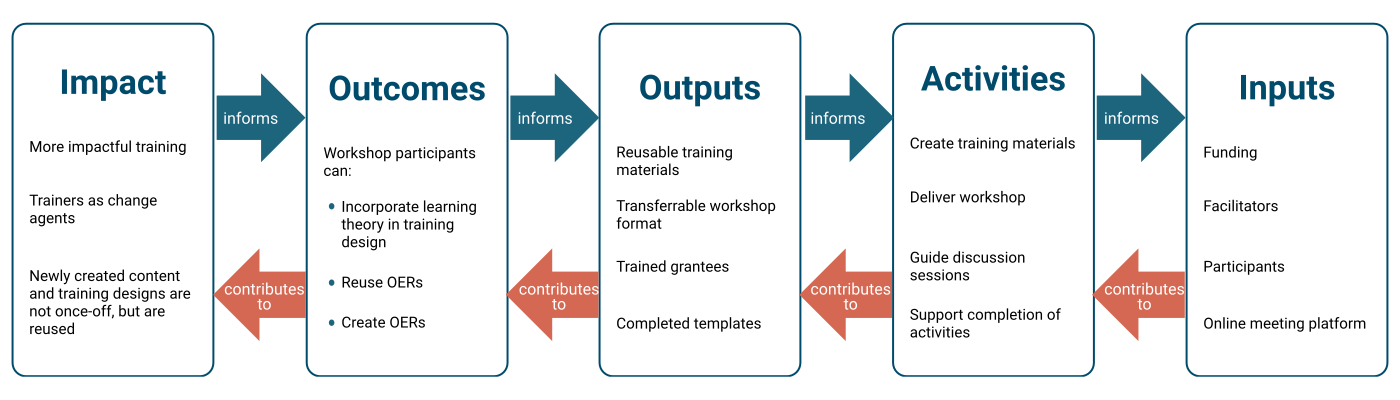
You'll return to your Theory of Change throughout this workbook — refining it as you define learning outcomes in Lesson 5, design activities in Lesson 7, and think about assessment in Lesson 9. Treat it as a living document, not a one-off exercise.
Your role in the system
Training is not neutral. The choices you make as a designer — what to include, whose examples to use, what counts as "good" performance — reflect your position, your background, and your assumptions about what matters.
This isn't a problem to solve; it's a reality to be aware of. Consider the difference between these roles:
| Role | What it looks like | When it fits |
|---|---|---|
| Instructor | You set the agenda, deliver content, assess outcomes | When learners need specific technical skills and you have clear expertise |
| Facilitator | You guide discussion and create conditions for learning, but participants drive the content | When learners have significant existing knowledge or the topic requires local adaptation |
| Co-designer | You build the training with participants, not just for them | When power dynamics matter, when local context is essential, or when you're an outsider to the community |
Most real training involves a mix of these roles. The key is to choose deliberately rather than defaulting to "instructor" because it's familiar.
Pause and reflect
Think about a training you've delivered or are planning. What role did you (or would you) naturally take? Who decided the content, the format, the success criteria — and who was left out of those decisions?
In practice
👉 Activity 2: Theory of Change — Build the logical chain from what you do to the impact you hope for, and surface the assumptions hiding in that chain.
Before you move on
You should now have:
- a draft Theory of Change with assumptions made visible
- a deliberate choice about your role (instructor, facilitator, co-designer, or a mix)
These are living documents
Nothing here needs to be final. Training design is iterative — your Theory of Change and role choice will evolve as you work through the rest of this workbook and as you learn more about your learners. Revisit and rework these outputs whenever your thinking shifts.
Further reading (optional)
-
Better Evaluation Knowledge Platform — Develop theory of change / programme theory
- Supports: Theory of Change linking activities to outcomes and impact
- Why it matters: explains how making assumptions explicit improves programme design and evaluation
- Source: https://www.betterevaluation.org/frameworks-guides/rainbow-framework/define/develop-programme-theory-theory-change
-
Freire, P. (1970) — Pedagogy of the Oppressed
- Supports: positionality, power, and the non-neutrality of education
- Why it matters: highlights how power relations shape participation and knowledge in learning environments
- Source: https://files.libcom.org/files/Paulo%20Freire,%20Myra%20Bergman%20Ramos,%20Donaldo%20Macedo%20-%20Pedagogy%20of%20the%20Oppressed,%2030th%20Anniversary%20Edition%20(2000,%20Bloomsbury%20Academic).pdf